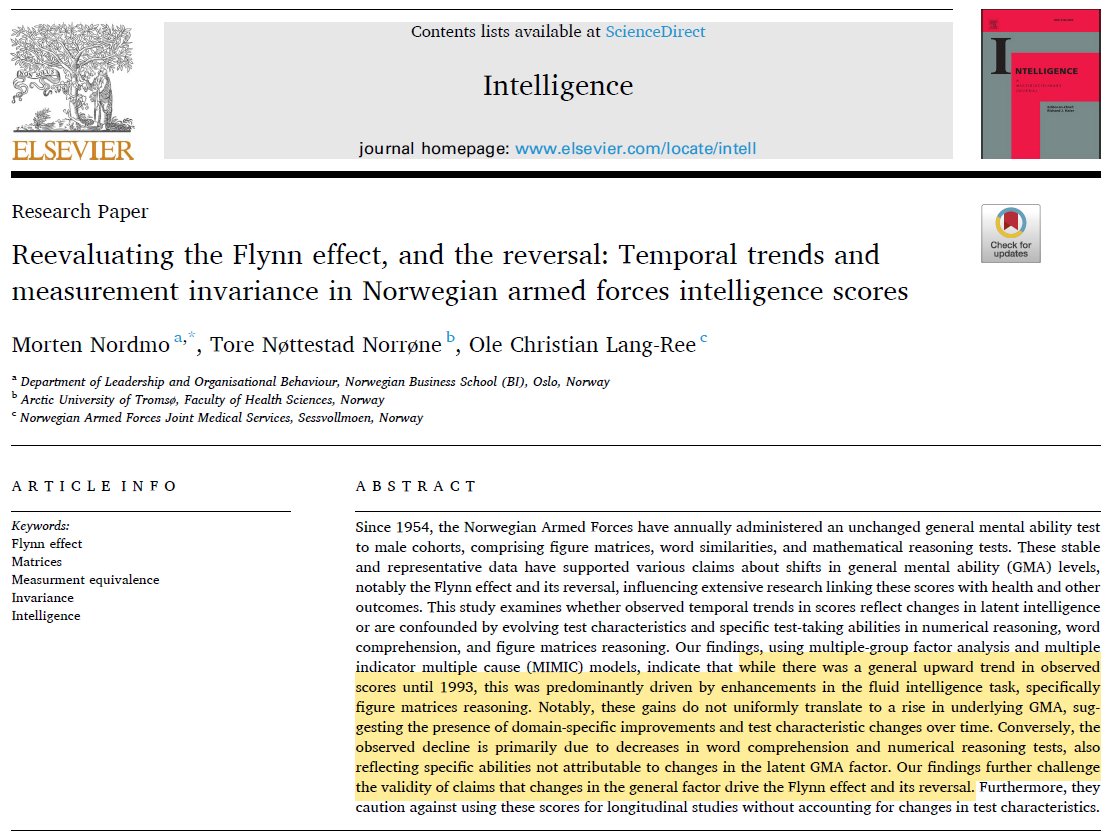
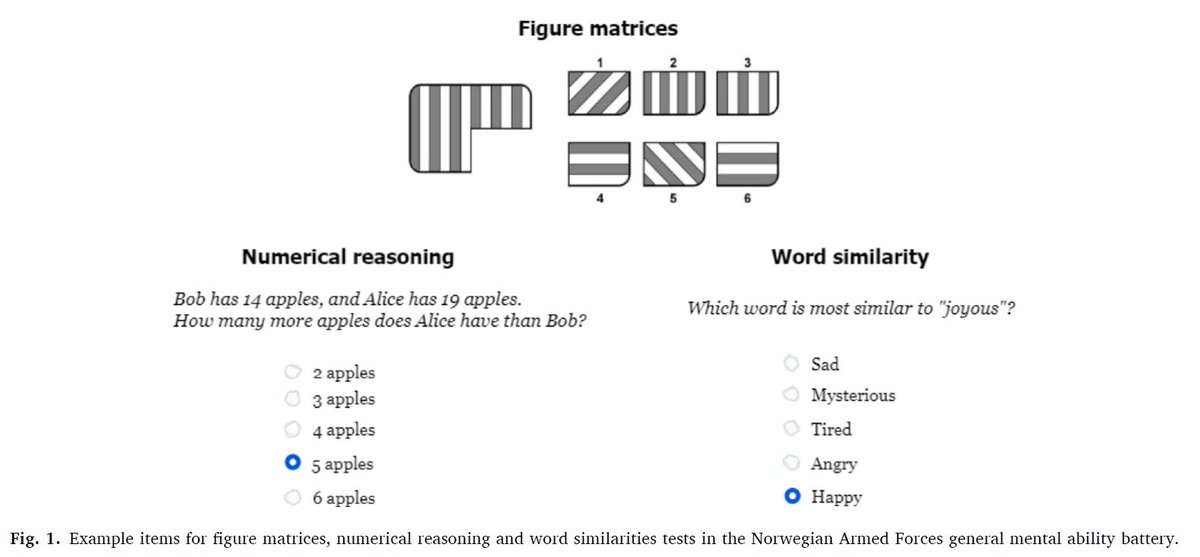
Norway has some of the best data for investigating the Flynn effect. The country tested nearly every young adult male with an intelligence test from 1957 through 2008 as part of the conscription process. (After that time, some men were filtered out and women were added to the examinee population.) The country also has never changed their intelligence test in that time. You can see example questions here:
These characteristics allow researchers to test whether the increase in scores is due to a change in test functioning or an actual increase in mental ability. The charts below show how scores on the three subtests (on the left) and the overall IQ (on the right) have increased from 1957 through 1993 before a decrease happened.
As the graphs show, fluid reasoning (i.e., matrix items) performance has been steady for the past generation, while vocabulary and math performance have decreased since the peak in 1993. In fact, math calculation is lower now than in 1957!
All of this (plus some other, more sophisticated analyses) means that the test is not functioning the same way now as it did when it was created. As a result, IQs on this test can NOT be compared apples-to-apples across years. This means that it is not possible to say that young adult in 1993 were smarter than their parents’ or their children’s generations.
This also means that the Flynn effect is a collection of increases and decreases acting independently on different tasks/subtests. The authors believe that vocabulary score decreases are due to the language from the 1957 test becoming antiquated. They also believe that the decreases in math calculation are due to a change in the Norwegian education system shifting away from hand calculation to conceptual math knowledge. Matrix reasoning, though, is all about patterns, and those have stayed an important part of thinking in the schooling system.
Findings like this help solve the paradox that James Flynn brought attention to in the 1980s. The fact that the score increase is due to specific test properties (and not a general increase in ability) is how the IQs could increase so much without people seeming to be massively smarter than their parents.
This Norwegian study is huge for understanding the Flynn Effect. The fact that matrix reasoning stayed flat while vocabulary and math dropped shows the “IQ gains” weren’t about getting smarter—they were about getting better at specific test content that matched what schools emphasized. The vocabulary decline makes total sense; words from 1957 are outdated now. And if schools shifted from rote calculation to conceptual math, of course hand-calculation scores dropped. This basically confirms the Flynn Effect is about cultural alignment with test content, not actual intelligence increases.
The math scores being lower now than in 1957 is wild! It really drives home that Flynn Effect gains aren’t about rising “general intelligence”, they’re domain-specific improvements based on what society emphasizes. Matrix reasoning stayed stable because abstract pattern recognition has remained relevant, but calculation skills tanked because calculators and different teaching methods made them less practiced. This undermines the idea that each generation is genuinely “smarter” and shows IQ tests are measuring culturally-influenced skills, not some pure cognitive essence.
@M.Evanta I see your point about cultural alignment, but I’m not entirely sold on discounting all general IQ gains. Isn’t it possible that the matrix reasoning would have dropped too, if not for some other factor like better nutrition or less childhood disease holding it steady? It staying flat might just show a pause in a slow, underlying cognitive gain, not absolute proof that zero general gain occurred.
@JuliaB This makes me wonder: If we accept that we sacrificed calculation speed for conceptual depth, was that trade-off worth it? Is the modern Norwegian adult now better equipped for the current economy than the 1957 adult was for theirs? It shows IQ tests are measuring what society emphasizes, but shouldn’t we ask if society is emphasizing the right things? Could the current generation actually perform worse if their calculators suddenly broke?
I don’t think it’s just cultural alignment with test content. If modern education shifts toward abstract reasoning and people genuinely develop stronger abstract thinking skills as a result, that’s a real cognitive gain and not just getting better at tests. The study shows we can’t measure general intelligence changes with this specific 1957 test, but that doesn’t mean the underlying abilities haven’t improved. We might actually be smarter in ways that matter for our current generation.
The real question isn’t “what if calculators break” but “are we developing the cognitive flexibility to adapt to whatever tools and challenges emerge next?” Abstract reasoning skills might be exactly what enables that adaptability.