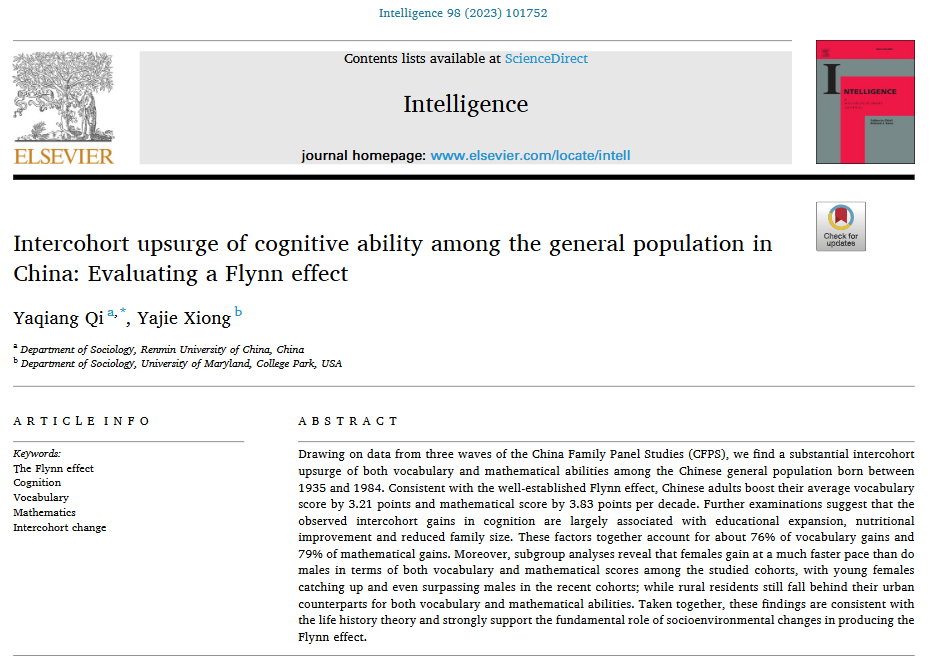
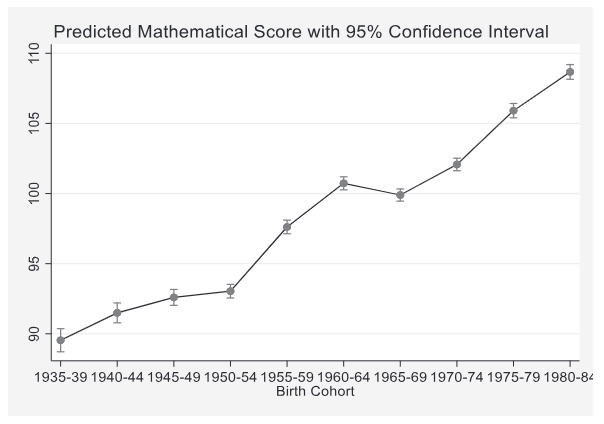
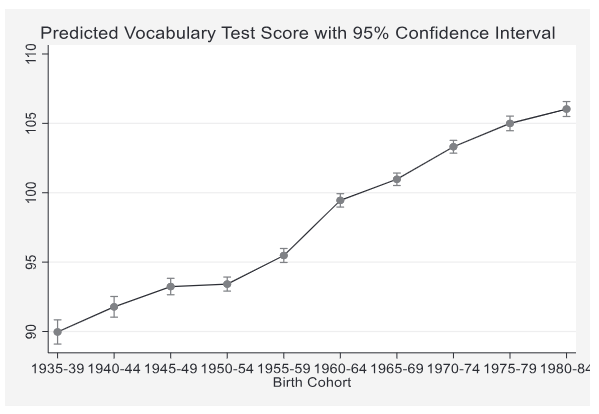
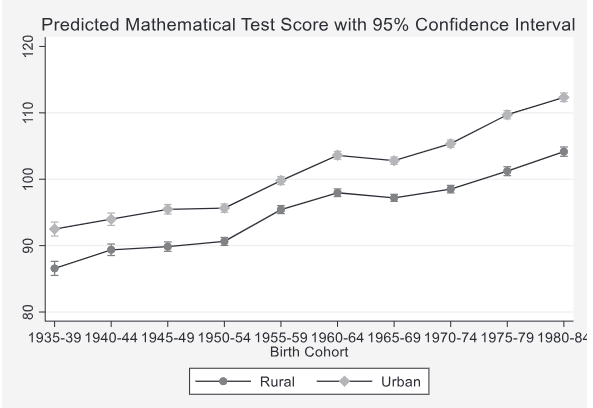
Recent studies have shown a slight decline in IQ test scores in some countries supporting the “Negative Flynn Effect” which called into question the Flynn effect’s sustainability. To evaluate the Flynn effect, the researchers examined how cognitive ability changed across different bright cohorts from 1935 to 1984 in mainland China. The study investigated the intercohort trend of cognition scores among the Chinese general population. To do this, five-year birth cohorts were constructed, and 10 groups of birth cohorts.
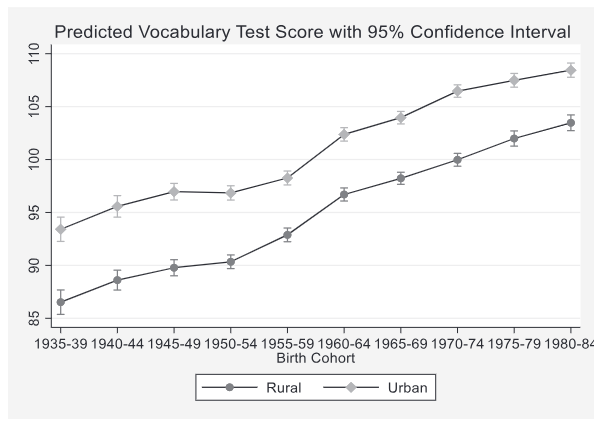
Based on results, there is evidently an increase in vocabulary and mathematical abilities across the different cohorts, therefore, verifying the Flynn effect in the largest population. The short dip in vocabulary could be caused by the emergence of new slang words and the dominant use of visual stimulations such as phones, TV, and video games affecting reliance on words/vocabulary in daily tasks. The socio-environmental factors were also studied using two dimensions of social stratification which are gender and place of residence.
I see the intercohort rise in IQ as a reflection of our species’ evolution for the better. This could also be a manifestation of the improvement in the accessibility of information and education for all. While the gender gap in cognitive ability is fortunately decreasing, more work, however, should be done for rural areas to close the rural-urban gap. Possible reasons could be unequal opportunities and access to resources.
There are talks about how intelligence of the kids nowadays is diminishing allegedly due to the early use of gadgets and their corresponding psychological effects. That’s why I think there are emerging studies on the sustainability of the Flynn effect. Personally, I believe that the Flynn effect exists, however, I also believe that psychological problems have also evolved and risen alongside the revolutionary effect of technology on society.
I’m skeptical. IQ tests mainly measure test-taking skill and abstract pattern recognition, which modern schooling trains for. This is a great report on educational effectiveness, not necessarily on a true species-level leap in ‘intelligence.’ Still good news though.
@houston.parkkonen139 But isn’t the ability to handle abstract pattern recognition part of what we mean by ‘intelligence’ in the modern world? A century ago, survival skills mattered more. The test simply reflects what the species is adapting to be good at.
The rural-urban gap is really striking in those graphs—almost a full standard deviation difference by the later cohorts. What’s interesting is that this isn’t just about genetics or innate ability, but clearly about access to education and resources. It makes you wonder what China’s true cognitive potential would be if rural areas had the same opportunities as urban centers.
@elwandarausch I agree the Flynn effect is real, but I think you’re right to be cautious about sustainability. The gains seem heavily tied to environmental factors like nutrition, education, and reduced family size—all things that can plateau or reverse. The “dip” concerns in Western countries might be early warning signs that we’ve maxed out the easy environmental improvements. China’s still catching up, so they’re seeing gains where developed nations are stalling.
I’d argue that this doesn’t entirely invalidate the significance of the Flynn effect. The improvement in these specific cognitive abilities still represents meaningful change. Even if we’re getting better at test-taking skills, those skills are still useful in navigating an increasingly complex world. The fact that education has evolved to develop these abilities more effectively is itself a positive adaptation.
We should still be cautious about conflating “doing better on IQ tests” with some universal measure of intelligence, though. Intelligence is multifaceted, and IQ tests certainly don’t capture other important cognitive dimensions. The real question is whether these measured improvements translate into better real-world problem-solving since that’s still being debated.