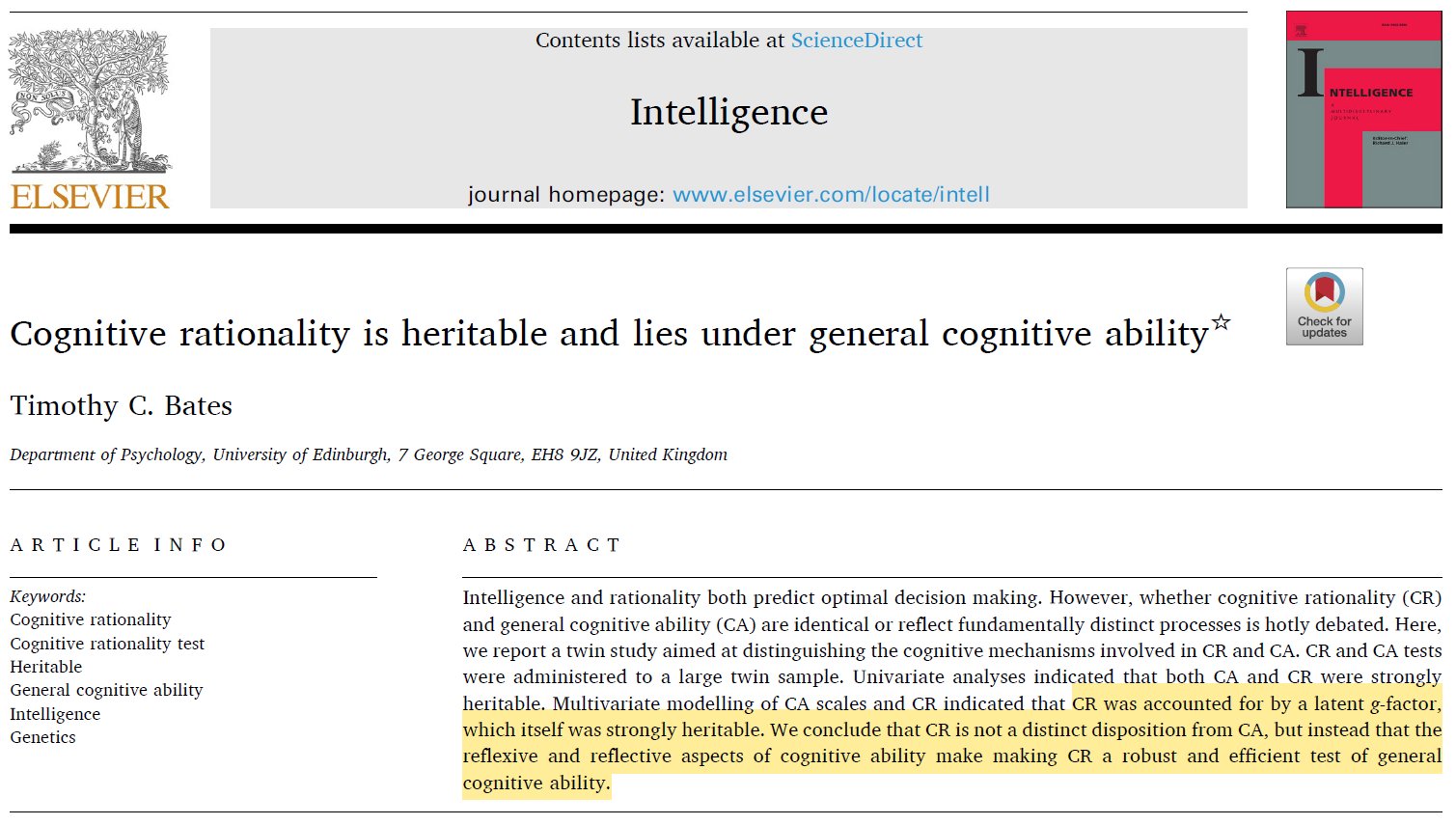
One recent claim is that general intelligence does not include an important characteristic of problem solving called “cognitive rationality” (CR). Therefore, CR would not be represented on traditional intelligence tests. A new article by Timothy Bates examines this possibility.
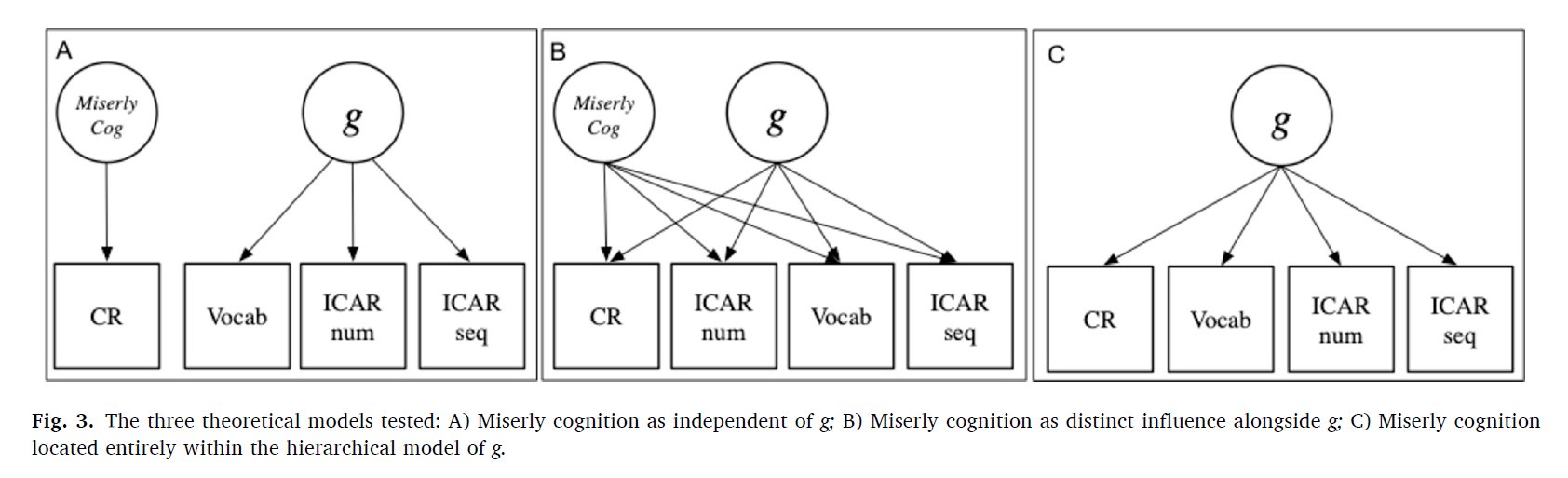
CR is a theorized trait that helps people be careful with their decision making and approach problems rationally, instead of leaping to conclusions. In this study, a sample of twins were administered an intelligence test and a CR test. Their data were used to test three statistical models, which are pictured below. Model A represents the claim that cognitive rationality is completely separate from intelligence. Model B represents the idea that CR and intelligence overlap, but that CR captures some unique problem solving ability. Finally, Model C would fit the data if intelligence overlapped completely with CR.
The results (below) showed that Model C was the best fit for the data. In fact, the CR test was a very good measure of intelligence, and it didn’t have much room to measure anything else. That means that CR is not a unique aspect of cognition. Rather, it is either the same as general intelligence or possibly a component of general intelligence.
“But wait! There’s more!” Because the sample consisted of twins, the author examined whether the scores in this study were heritable. Indeed, they were, with the CR score being about average compared to the scores from a traditional intelligence test. The underlying intelligence factor was also found to be highly heritable. (No surprise there.)
A theory is only as strong as its ability to withstand attempts to disprove it. And intelligence theory has been the target for these falsifiability tests for decades. “Cognitive rationality” theory is the latest attempt to dethrone general intelligence from its place as the most important cognitive ability. CR failed to supplant general intelligence–and g theory came out stronger than ever!
This is a really elegant study design. Using twin data to test whether CR is actually distinct from g is smart—if it was truly a separate ability, you’d expect different genetic architectures. The fact that Model C fit best (CR completely within g) is pretty damning for the idea that rationality tests measure something IQ tests miss.
So basically, tests claiming to measure “rational thinking” separate from IQ are just measuring IQ with extra steps? That’s kind of hilarious but also reassuring—it means traditional intelligence tests aren’t missing some huge piece of the puzzle like critics claim. The 70% loading of CR onto g is really strong evidence.
@NickFR You nailed it. Every few years, someone tries to carve out a new “uniquely important” cognitive ability, like Emotional Intelligence, or now Cognitive Rationality, to claim IQ tests are too narrow. But time after time, when you subject these traits to proper factor analysis, g just absorbs them. It’s a huge victory for the classical psychometric model. g isn’t just about speed; it includes the ability to think carefully and rationally. The theoretical elegance of g is truly astounding.
@houston.parkkonen139 While the statistical elegance of g is undeniable, we have to acknowledge why people try to carve out traits like CR. The reality is that someone with a high IQ might still make terrible financial decisions or fall for obvious scams. This behavioral gap is what the critics are trying to explain. The study proves the capacity is g. But the disposition (i.e., the willingness or motivation to use System 2 reflective thinking) is what’s missing from the g score, and that’s usually where personality factors take over.
This is a really elegant study design. Using twin data to test whether CR is actually distinct from g is smart—if it was truly a separate ability, you’d expect different genetic architectures. The fact that Model C fit best (CR completely within g) is pretty damning for the idea that rationality tests measure something IQ tests miss.
Yeah, the twin design really nails it down. What struck me is how little variance the CR test captured beyond g. It’s like, there wasn’t even room for it to measure something else. Maybe those other “new” cognitive constructs are just g in disguise.
This is a really elegant study design. Using twin data to test whether CR is actually distinct from g is smart—if it was truly a separate ability, you’d expect different genetic architectures. The fact that Model C fit best (CR completely within g) is pretty damning for the idea that rationality tests measure something IQ tests miss.
I’m curious whether this generalizes beyond this particular CR test. Could there be aspects of rational thinking that just aren’t well-captured by current measurements? Or is this pretty conclusive that rationality = intelligence?